

Research conducted within the framework of the Center of Excellence in Plant-Environment Interactions (CEPEI), an international collaboration, has identified "the genetic and transcriptomic responses of Brassica napus to nitrogen and phosphate starvation at standard temperature or combined with heat stress.
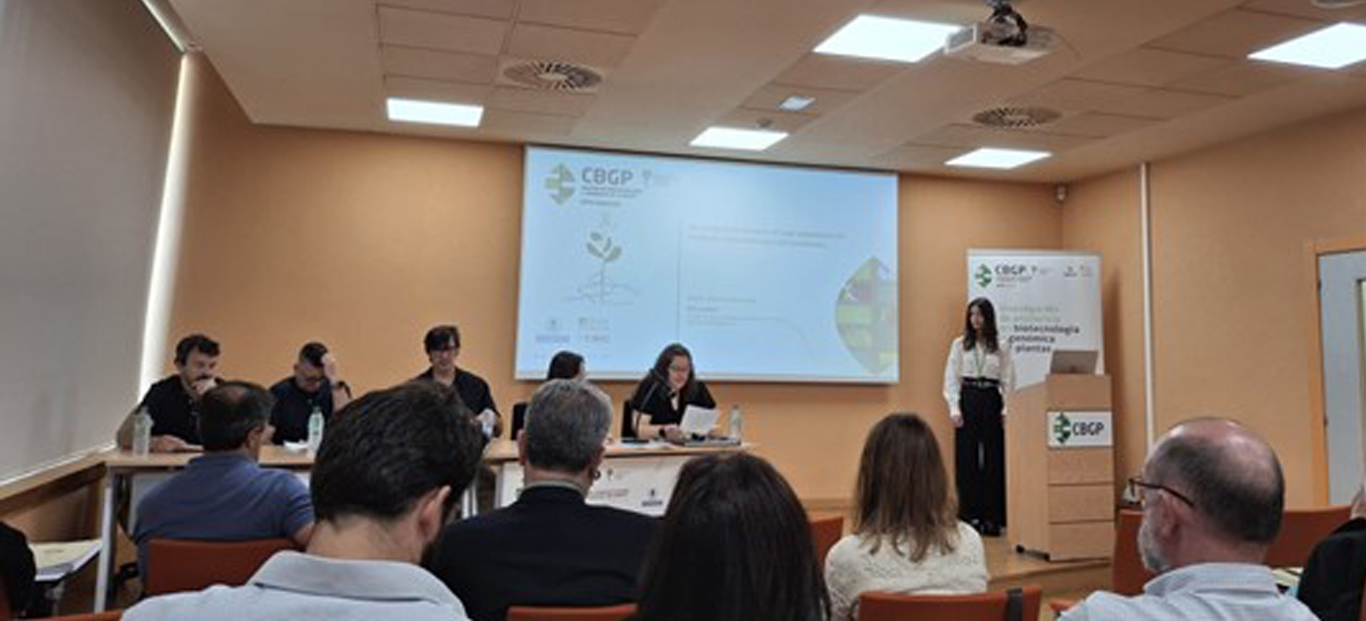
Dr. Maria Sanchez Bermudez, during her thesis defense.
The thesis of Maria Sanchez Bermudez, awarded the Cum Laude distinction, showed how the crop Brassica napus respond to the combination of low essential macronutrients, nitrogen (N) and phosphate (Pi) with temperature stress. In this context, the morphological and physiological responses of different varieties of B. napus have been analysed, and the transcriptomic response of two varieties with differential responses to these combined stresses was analysed. These analyses allowed the identification of a set of transcription factors that are relevant for the combined response to N or Pi and temperature stress. Furthermore, in response to N deprivation, a set of Pi starvation response genes were altered, suggesting an interconnection between both macro-elements. Additionally, her work had also identified a master regulator of the Pi starvation response, the gen PHR1-like, in Brassica, suggesting that this response works similarly, at least in part, to the one described in Arabidopsis. This work opens new avenues for designing crops that use nitrogen and phosphorus more efficiently as well as more tolerant to nutrient limitation and heat stress, conditions that are becoming increasingly common due to climate change, thereby contributing to a more sustainable agriculture and increased food production.
An Example of International Collaboration with Global Impact
The doctoral thesis, supervised by professors Monica Pernas and Juan Carlos del Pozo, is the first within the CEPEI program, which unites renowned institutions in Spain and China: The Institute of Genetics and Developmental Biology (IGDB) in Beijing, the Center for Excellence in Molecular Plant Sciences (CEMPS) in Shanghai, and the Center for Plant Biotechnology and Genomics (CBGP) in Madrid. During her research, Dr. Maria Sanchez Bermudez completed an international stay in Dr. Mingguang Lei's laboratory at Shanghai Center for Plant Stress Biology (PSC), CAS Center for Excellence in Molecular Plant Sciences (CEMPS). This experience in an environment of scientific excellence enabled her to advance her study of Brassica response to combined stresses and the recognition for her thesis.
Due to her work, the researcher has participated in four publications in prestigious scientific journals, including a publication in the journal Nature Communications (2025) and Plant Communications (2022).
Author's publications:
- Ge, S., Li, Jinkai, Ma, Hui, Sánchez-Bermúdez, María, Wu, Siqun, Lv, Qiuyu, Guo, Fengxiao, Dong, Jinsong, Ma, Guojie, Li, Qingshun Quinn, Satheesh, Viswanathan, Lei, Mingguang. (2025). "A cis-natural antisense RNA regulates alternative polyadenylation of SlSPX5 under Pi starvation in tomato." Nature Communications 16(1): 7981. https://doi.org/10.1038/s41467-025-63406-1
- González-García, Mary Paz, Conesa, Carlos M., Lozano-Enguita, Alberto, Baca-González, Victoria, Simancas, Bárbara, Navarro-Neila, Sara, Sánchez-Bermúdez, María, Salas-González, Isai, Caro, Elena, Castrillo, Gabriel, del Pozo, Juan C. (2022). "Temperature changes in the root ecosystem affect plant functionality." Plant Communications: 100514. https://doi.org/10.1016/j.xplc.2022.100514
- Sánchez-Bermúdez, M., del Pozo,Juan C., Pernas,Mónica (2022). "Effects of Combined Abiotic Stresses Related to Climate Change on Root Growth in Crops." Frontiers in Plant Science 13. Doi: https://doi.org/10.3389/fpls.2022.918537